

Match Each Type of TrueView Ad to Its Bidding Approach: The Complete 2026 Guide

If you’ve ever sat through a Google Ads certification exam or tried to set up a YouTube video campaign, you’ve probably run into this exact question: match each type of TrueView ad to its bidding approach. It sounds simple, but the honest answer has gotten more layered in the last two years, because Google has quietly renamed, merged, and upgraded several of these formats. This guide breaks down every TrueView (and TrueView-adjacent) ad format, pairs it with the bidding strategy it actually uses today, and explains why the pairing works the way it does.
Feature Image
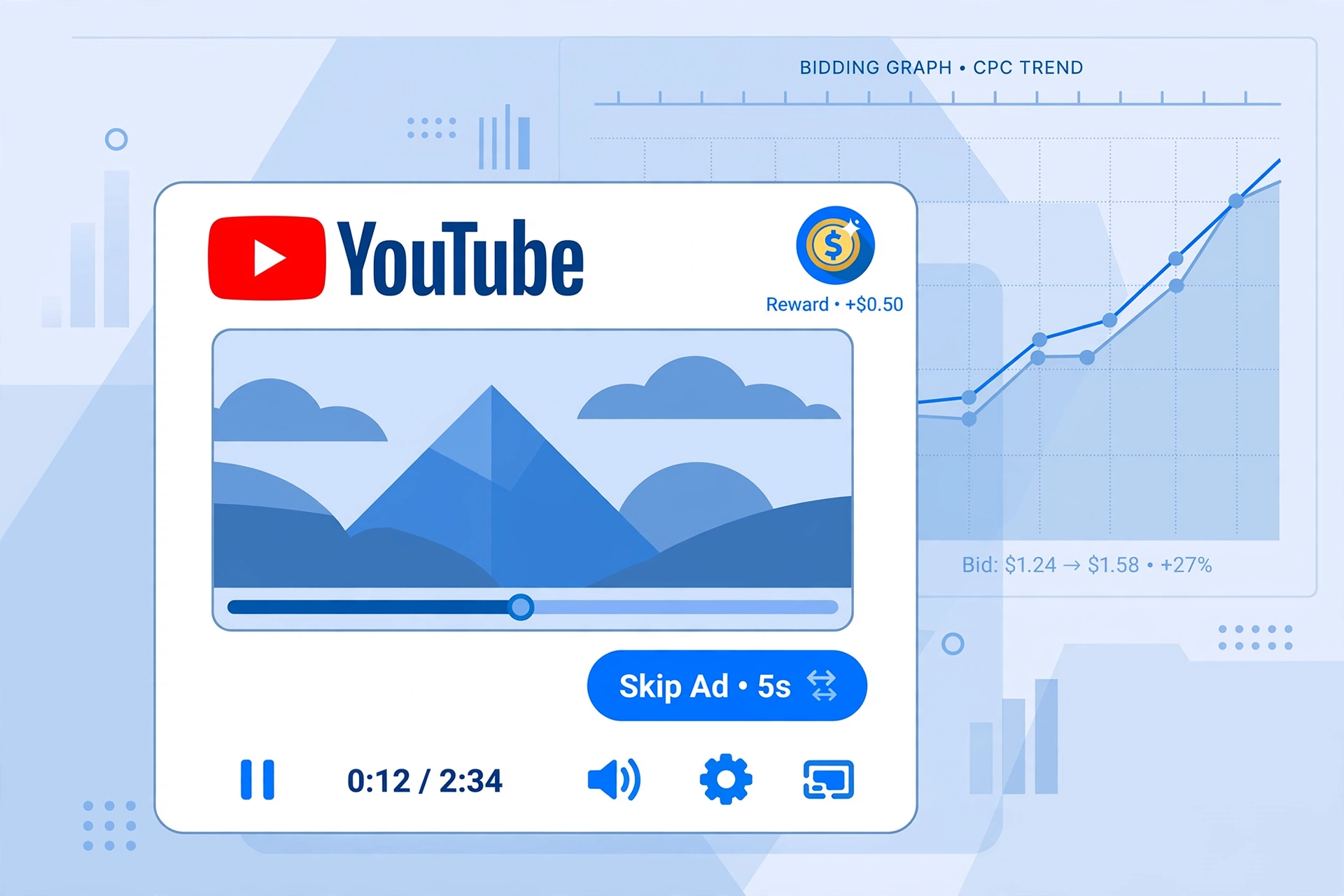
- Prompt: A clean, modern flat-design illustration of a YouTube video player with a skip button, a small dollar-sign coin icon, and a bidding graph in the background, in a blue and white tech color palette
- Alt text: Illustration showing a YouTube video ad player with a skip button and cost-per-view bidding graph
- Title: TrueView Ad Types and Bidding Approach Guide
- Caption: Matching every TrueView ad format to the right bidding strategy in Google Ads
- Description: A conceptual illustration representing how YouTube TrueView video ad formats connect to their corresponding Google Ads bidding strategies, including CPV, CPA, and CPM models
What “TrueView” Actually Means Today
Before matching formats to bids, it helps to clear up a naming issue that trips up almost everyone searching this topic. TrueView was originally the umbrella brand for all skippable, pay-per-engagement YouTube ads. As of the naming updates that rolled out through 2025 and 2026, <cite index=”10-1,13-1″>the “Views” metric is now labeled “TrueView views” in Google Ads, and Google has been evolving TrueView In-stream and In-feed for Consideration campaigns into Video view campaigns powered by Google AI</cite>. In practical terms, “TrueView” today functions more as a billing concept — you only pay for a genuine, engaged view — than as a single campaign type you pick from a dropdown. You can read the official breakdown on the Google Ads Help page for video ad formats.
That said, the classic exam-style question still refers to the four formats most advertisers actually work with: TrueView In-Stream, TrueView Discovery (now called In-Feed), TrueView for Action, and Bumper Ads (which sit alongside TrueView even though they aren’t skippable). Here’s how each one maps to its bidding model.
1. TrueView In-Stream Ads → Maximum CPV (or Target CPV)
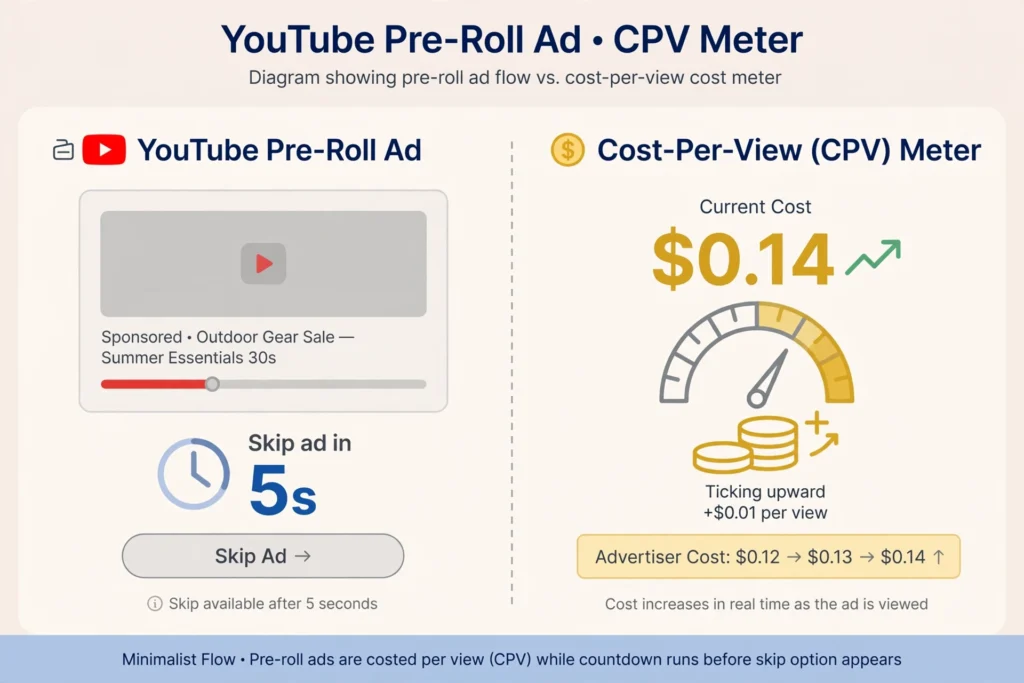
TrueView In-Stream ads are the skippable ads that play before, during, or after another YouTube video, with a skip button appearing after five seconds. <cite index=”16-1″>TrueView In-Stream is optimized for video views or brand awareness</cite>, which is why it pairs naturally with cost-per-view bidding rather than a click- or conversion-based model.
Bidding approach: Maximum CPV (Cost-Per-View), and in newer multi-format Video view campaigns, TrueView target CPV (tCPV).
- With Maximum CPV, you set a ceiling on what you’re willing to pay for a qualifying view, and Google’s auction never charges you above that cap.
- <cite index=”12-1″>If you use a Video view campaign with multi-format ads, your bid is TrueView target cost-per-view, where you set the average amount you’re willing to pay for each TrueView view your campaign receives</cite>.
- Billing is view-based, not click-based: <cite index=”10-1″>with CPV bidding, you pay when a viewer watches 30 seconds of your video, or the entire duration if it’s shorter, or interacts with your video — whichever comes first</cite>.
This is the format built for brand storytelling. Because viewers who skip within the first five seconds cost you nothing, In-Stream with CPV bidding rewards genuinely engaging creative rather than aggressive frequency.
2. TrueView In-Feed Ads (Formerly TrueView Discovery) → Cost-Per-Click, Billed as CPV
In-Feed ads look like organic thumbnails and text, appearing in YouTube search results, the Home feed, or as related videos next to content someone is already watching. Instead of playing automatically, the viewer has to click the thumbnail to start the video — and that click is what counts as the chargeable “view.”
Bidding approach: Cost-per-view bidding, triggered by a click rather than autoplay engagement.
Even though the underlying auction still runs on a CPV structure, the mechanic is different from In-Stream: you’re only charged when someone actively chooses to click and watch, which tends to produce a smaller but more intent-driven audience. This makes In-Feed ideal for content marketers who want viewers who are already curious rather than viewers who happened to be watching something else.
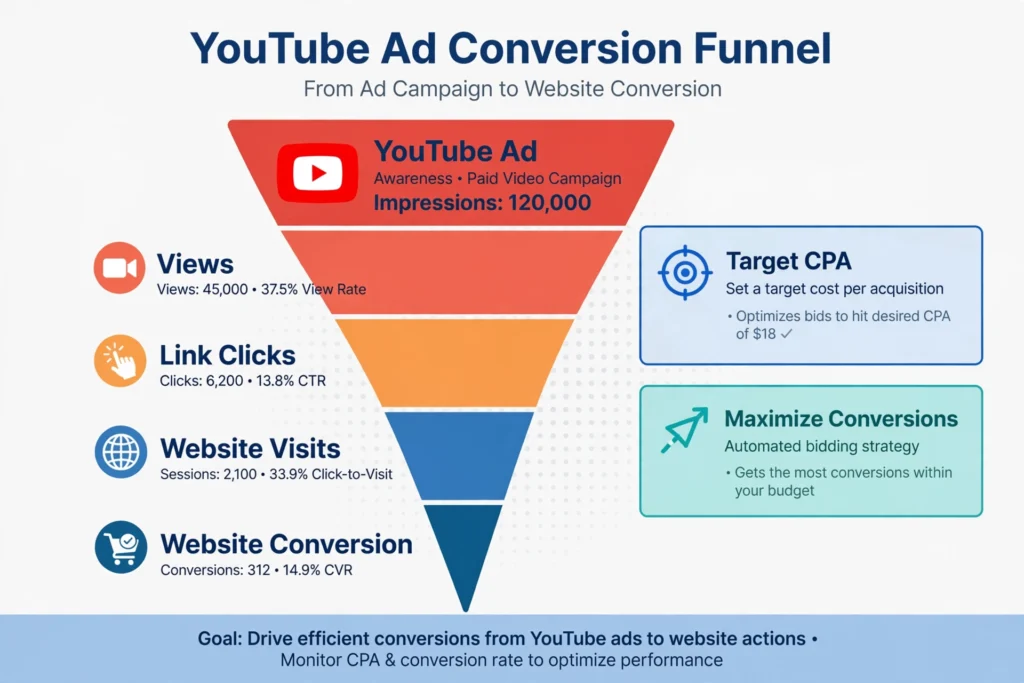
3. TrueView for Action → Target CPA or Maximize Conversions
TrueView for Action ads add a clickable call-to-action overlay, a headline, and sometimes a companion banner directly on top of an In-Stream ad. These exist specifically to drive website visits, leads, or sales rather than pure brand awareness.
Bidding approach: Target CPA (Cost-Per-Acquisition) or Maximize Conversions.
- <cite index=”16-1″>TrueView for Action adds a clickable call-to-action overlay and uses conversion-based bidding, specifically Target CPA or Maximize Conversions</cite>.
- <cite index=”14-1″>When you choose leads or sales as your campaign objective, Google locks you into TrueView for Action, meaning you can only use conversion bidding strategies like Maximize Conversions or Maximize Conversion Value</cite>.
- For Target CPA specifically, reliable optimization needs a real conversion history — <cite index=”15-1″>Target CPA bidding optimizes delivery toward users most likely to convert, and generally requires at least 30 conversions in the prior 30 days to work well</cite>.
This is the format to choose when the KPI is form fills, purchases, or sign-ups rather than views or reach. Smart Bidding does the heavy lifting here, shifting impressions toward the audience segments most likely to complete your goal action.
4. Bumper Ads → Target CPM
Bumper ads are the six-second, non-skippable clips built purely for reach and recall. <cite index=”9-1″>These are very short, non-skippable clips up to six seconds, great for quick reminders and brand recall, but less suited for detailed offers or explanations</cite>. Because there’s no skip option and no click expectation, per-view bidding doesn’t make sense here — you’re paying for reach, not engagement.
Bidding approach: Target CPM (Cost-Per-Thousand-Impressions).
- <cite index=”15-1″>For awareness campaigns, Target CPM bidding is used with bumper and non-skippable formats, and setting bids 10–15% above the suggested range can help win premium inventory placements</cite>.
- Target CPM optimizes for reaching as many unique viewers as possible within budget rather than for watch-time or clicks.
While bumper ads aren’t technically classified as “TrueView” (since there’s nothing to skip), most exam-style questions and real-world media plans still group them into the same YouTube video-bidding discussion, so it’s worth knowing where they fit.
Quick Reference: TrueView Format-to-Bidding Match
| Ad Format | Primary Goal | Bidding Approach |
|---|---|---|
| TrueView In-Stream | Views / brand awareness | Maximum CPV or Target CPV |
| TrueView In-Feed (Discovery) | Intent-driven engagement | CPV, charged on click |
| TrueView for Action | Leads / sales / conversions | Target CPA or Maximize Conversions |
| Bumper Ads | Reach / recall | Target CPM |
Why the Bidding Model Always Follows the Objective
The pattern across every format above is the same: Google ties the bidding model to what you’re actually asking the ad to do. View-focused formats bid on CPV so you only pay for genuine attention. Conversion-focused formats bid on CPA or Maximize Conversions so Smart Bidding can chase the outcome you care about. Pure-reach formats bid on CPM because impressions, not engagement, are the currency that matters.
This is also why campaign selection in Google Ads increasingly nudges you toward an objective first, format second. <cite index=”4-1″>Different campaign types match different business needs across the customer journey, and Performance Max now uses Google AI to serve ads across Search, Display, YouTube, Discover, Gmail, and Maps from a single campaign</cite>, blending some of what TrueView used to do in isolation. Even so, understanding the classic TrueView-to-bidding pairings is essential, both because standalone Video view campaigns still exist and because the underlying logic — match the payment model to the marketing goal — carries over into every newer format Google introduces.
For deeper technical detail on how the auction itself calculates your cost per view, the Google Ads Help article on CPV bidding is the most reliable primary source, and Think with Google’s overview of YouTube TrueView is a useful companion read for the strategic side of format selection.
Final Takeaway
If you remember nothing else, remember this: views pair with CPV, conversions pair with CPA or Maximize Conversions, and pure reach pairs with CPM. TrueView In-Stream and In-Feed chase attention, TrueView for Action chases outcomes, and Bumper ads chase exposure — and each one’s bidding strategy exists to protect your budget against paying for the wrong kind of result.